swift · 2026-08-14 · 8 min read
Forking a macOS app, rebuilding its interface, and learning what a release pipeline actually inherits
Why this exists
I had four agents running and no idea which of them was stuck. Claude Code sessions live in terminal windows, and a buried terminal window tells you nothing. An agent that finished, an agent that crashed, and an agent sitting at an approval prompt all look identical from the outside. Which is to say invisible.
so-agentbar already solved the hard half of that. It watches four different Claude session directories with FSEvents, parses Codex rollout logs, keeps per-model cost tables, and folds sub-agents into the session that spawned them. I forked it because that machinery was worth having and I didn't want to build it twice.
Everything above that machinery I replaced.
Deleting first
The first three commits were subtraction. The app shipped a floating SpriteKit window of animated pixel-art characters, one per session, plus CPU and memory "pets" that moved faster under load. Charming feature. It also had nothing to do with why I'd installed the thing, so out it went: eight source files, sixty-six sprite assets, four test suites, roughly 5,200 lines.
The trap in that deletion was one distinction. SystemPetNode.swift drew an
animated sprite. SystemMetricsView.swift drew the CPU and memory readout in
the popover. They share a data source and nothing else, so deleting both would
have been an easy mistake and a silent regression, because no test in the suite
covers a view.
Then Korean. The app was bilingual, with a store.t("한국어", "English") helper
called about 245 times across sixteen files. Collapsing those to their English
argument is mechanical until you hit store.t("\(n)개", "\(n) items"), where a
naive regex eats the interpolation. What actually caught me out was something
else. store.t wasn't the only localisation path. UsageMonitor carried its own
localizer closure wired to the same helper, and several strings were
Korean-only with no English counterpart, so there was nothing to collapse them
to and they needed real translation.
The design language I added and then removed
The app targeted macOS 14. I raised the floor to 26 and rebuilt the popover on
Liquid Glass, with .glassEffect() on the tab switcher, a GlassEffectContainer
grouping the chrome, and the selection morphing between tabs.
Then I looked harder at a reference design I liked more. The note.md system is black ink on paper white, squared corners, hairline rules, and exactly one very soft shadow in the whole token set. That is the opposite material philosophy. Liquid Glass expresses hierarchy through translucency and shadow; the other expresses it through stepped neutral surfaces. You can't blend them. Keeping glass on one surface would have read as two designs stapled together.
So the glass came back out, one commit after it went in.
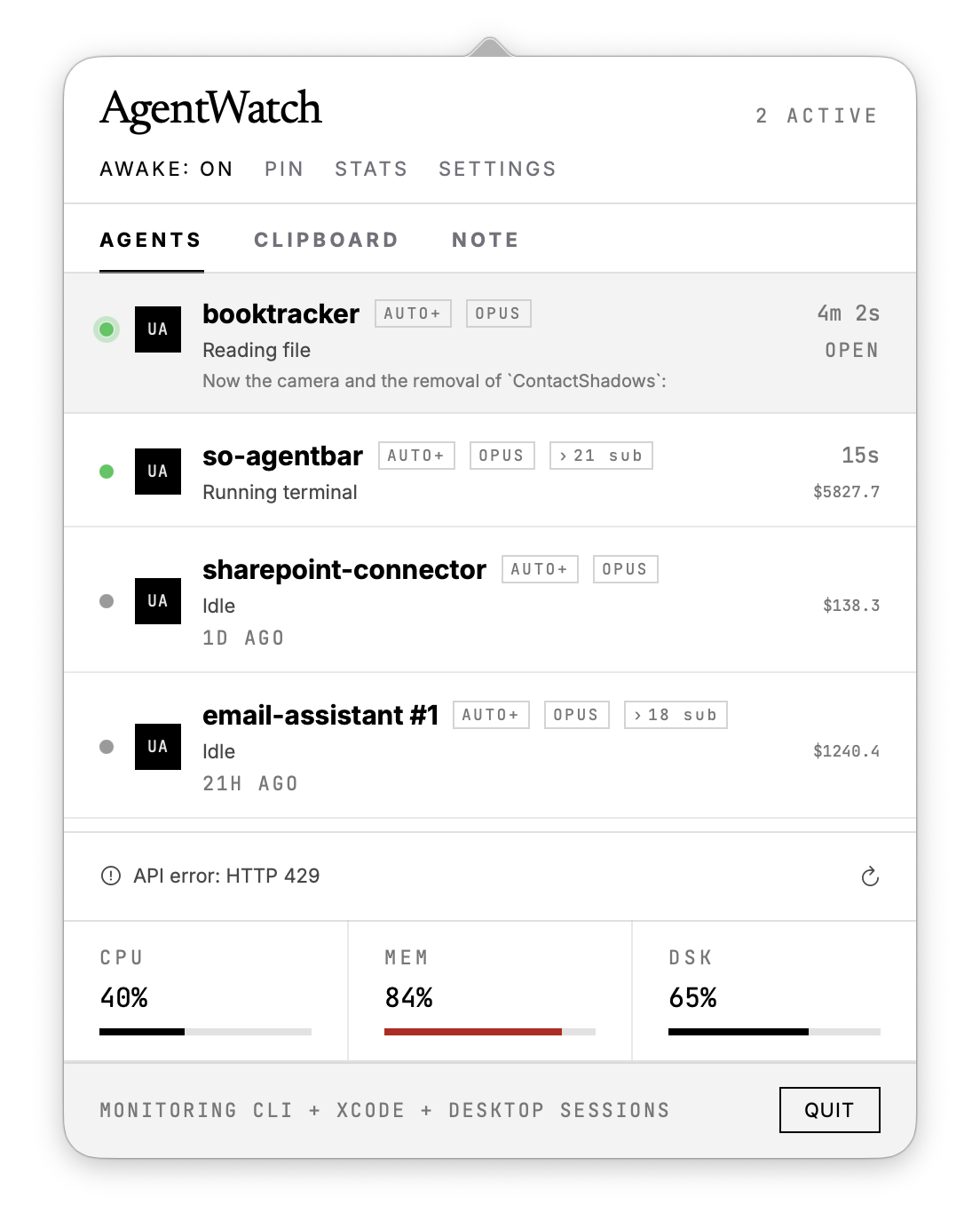
Reserving colour did the most work. Before, a row carried a green or orange permission badge, a grey model badge, a per-source coloured icon, and a purple sub-agent count. After, those are one uniform bordered mono chip and the entire hue budget goes to agent status. I verified that instead of trusting it. Render the popover offscreen, count pixels, and 0.09% of the frame comes back chromatic, all of it the status dot.
That measuring habit mattered more than I expected. I bundled the three typefaces the reference specifies, Newsreader and Inter and JetBrains Mono, all SIL OFL and all variable fonts carrying optical size axes. Their wider metrics immediately broke two fixed-width layouts that had been sized against SF Mono. A seven-character token count was being clipped rather than wrapped, which is the kind of thing nobody notices until someone screenshots it. The Settings tab row needed 531pt of the 440pt available and had been quietly wrapping.
The part I actually learned from
I'd never shipped a signed, notarised Mac app outside the App Store. I assumed
the hard part would be the Apple side. Wrong. notarytool is genuinely
pleasant, and Apple came back with Accepted on the first submission.
The hard part is that a fork inherits a release pipeline configured for someone else, and each piece of that configuration fails in its own way.
The workflow itself was fine. .github/workflows/release.yml imports a
certificate, stores notarisation credentials, builds a DMG, signs an appcast,
publishes to Pages. What was wrong was every value it operated on.
The signing identity was hardcoded to the original author.
SIGN_IDENTITY="Developer ID Application: HyeonSeop So (X5NBG68P4L)"A certificate I don't hold, on a team I'm not in. That one fails loudly in CI, which is the good case.
The Sparkle public key belonged to upstream. Info.plist carried an
SUPublicEDKey whose private half lives on someone else's machine. Updates
signed by me would have failed validation on every install, with no error a user
could act on. The fix is a new EdDSA pair, and then checking that the exported
private key really does produce the public key sitting in the plist. A mismatch
there stays invisible until an update silently refuses to install.
The appcast had a real release in it. docs/appcast.xml still listed
upstream's v1.11.0. Had I switched auto-update on with that file in place,
Sparkle would have read it as an available update and offered my users a
different application.
The minimum system version was a lie. This is the one I nearly shipped.
printf ' <sparkle:minimumSystemVersion>14.0</sparkle:minimumSystemVersion>\n'Hardcoded 14.0, inside a generator for an app that now requires macOS 26.
Sparkle would have offered the build to every Sonoma and Sequoia user, each of
whom would have downloaded it and found it wouldn't launch. I'd been careful
about exactly this hazard a few hours earlier, deliberately leaving the
historical 14.0 entry alone in the appcast so existing users kept their last
working version. Then I walked straight past the same number, one file over.
And 33 git tags came with the fork. v1.0.0 already existed. It pointed at
sotthang's initial commit from March. So git tag v1.0.0 fails outright, and a
git push --tags would have published 33 GitHub releases under my name, for
versions I never shipped. My remote had no tags yet, so nothing broke. I found
it with about a minute to spare.
Did it work?
Yes. I checked it the way I'd check anything else, by looking at the artefact rather than the green tick. I downloaded the published DMG from the release page and asked Apple's own tooling about it.
$ xcrun stapler validate AgentWatch.dmg
The validate action worked!

$ spctl -a -vvv -t install /Volumes/AgentWatch/AgentWatch.app
accepted
source=Notarized Developer ID
origin=Developer ID Application: ARSoftware UG (haftungsbeschraenkt) (8VHV8VJK49)
Byte length matches the appcast, version reads 1.0.0, feed URL points where it should. A stranger downloading it gets no Gatekeeper warning.
One thing is still genuinely untested, and I'd rather say so than pretend otherwise. The update path. Sparkle needs two published versions before there is anything to compare, so the first real test of that key pair and that feed will be v1.0.1.
The lesson
Forking is not free, and the cost isn't in the code. Code is the part you can read. What comes with it invisibly is a set of assertions about identity. Whose certificate signs this. Whose key verifies updates. Which URL the app phones home to. Which version numbers already exist. Every one of those was correct for sotthang and wrong for me, and only one failed in a way I could have missed.
The two that scared me were the quiet ones. A Sparkle key mismatch throws no
error, it just means updates never install. A hardcoded minimumSystemVersion
throws no error either, it just hands your app to people who can't run it. Both
were single lines, in files I had already read.
So, the rule I took away. After forking, grep for every constant that names a person, a team, a domain or a version, and treat each one as wrong until you have replaced it. I found five. I'm not certain there wasn't a sixth.
Written with AI from my own repositories and notes, reviewed and published by me. How this site is written